Framework
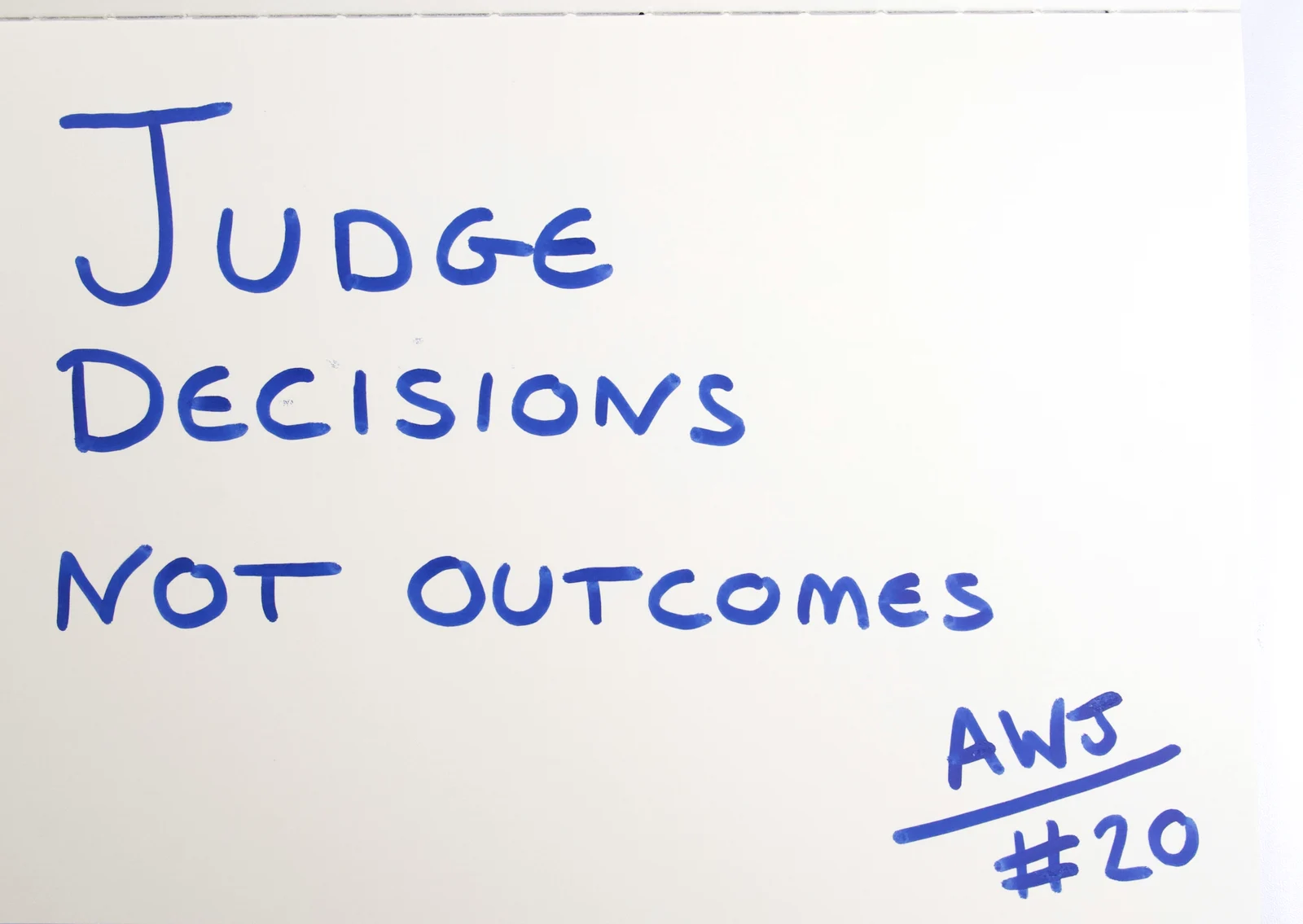
Judge Decisions, Not Outcomes
A way of reviewing performance that separates the quality of a decision from the luck in its result.
The steps
- Write the outcome down, then set it aside.
- Reconstruct what the person knew and when they knew it, in MEDDPICC terms.
- Ask what the best available decision was with that information, and whether it was the one taken.
- Grade the decision on its own, then grade the process that produced the information.
- Reward good decisions that lost and correct bad decisions that won, out loud, so the team learns the rule.
Judge decisions, not outcomes. Sales is a game of probabilities played with incomplete information, which means good decisions lose and bad decisions win, often enough to fool anyone who only looks at the scoreboard. A rep who forecasts a deal with no Economic Buyer, no Metrics and a Coach they call a Champion, and then closes it because the customer’s CFO happened to have budget to burn in December, has made a bad decision with a good outcome. A rep who qualified out of a deal that a competitor later won has often made a good decision with a bad outcome. If you reward the first and punish the second, you are training your team to gamble.
It exists because outcomes are loud and decisions are quiet. The number is on the dashboard. The decision that produced it is buried in a CRM note from eight weeks ago, if it was recorded at all. Left alone, every review drifts towards the result, and results carry luck in them that nobody can coach. Decisions can be coached. They are the leading indicator. The outcome is the lagging one.
How to run it
Take the result and put it to one side. Then go back to the point of decision and reconstruct what was known. In a deal, that means the state of MEDDPICC at the time: which letters were proven, which were assumed, which were blank. Ask what the best available decision was with that information. Was committing the deal reasonable? Was walking away reasonable? Was spending another month on it reasonable? Then compare it to the decision actually taken. Grade that, out loud.
Finally, grade the process that produced the information. A rep who made a sound decision on bad information has a discovery problem, which is a different conversation from a judgement problem.
Then do the uncomfortable part. Praise the good decision that lost, in front of the team. Correct the bad decision that won, in private but clearly. Both feel wrong in the moment. Both are the only way a team learns that the rule is real.
Where it breaks
It breaks when it is used as an excuse. “It was a good decision at the time” has to be earned by showing what was known at the time, and a rep who cannot reconstruct that has not earned it. It breaks when leaders apply it to others and not to themselves. The forecast you called, the hire you made and the territory plan you signed off deserve the same review. It breaks under quarter-end pressure, when a leader who believes in the rule on the first of the month abandons it on the thirtieth because the number is the number.
And it breaks if you drop outcomes entirely. Outcomes still matter. They are the scoreboard, and over a long enough run of decisions they are also the best evidence of whether the decisions were any good. Judge the decisions first. Let the outcomes accumulate.
From the journal